
Cash is having a moment. Short-term Treasury bills are yielding roughly 4%, money market fund assets have reached nearly $8 trillion, and keeping money liquid no longer feels like accepting almost no return.
That is genuinely useful. Cash can provide stability, meet near-term obligations, and keep you from selling long-term investments at an inconvenient time. But a quoted yield is not the same as an economic return. Taxes reduce what you keep, inflation reduces what that money can buy, and a rate available today may not be available when the account or security resets.
The better question is not simply, “What is my cash yielding?” It is:
What job is this cash doing—and what return remains after tax and inflation?
Four numbers worth putting in context
Sources: Federal Reserve, U.S. Treasury, U.S. Bureau of Labor Statistics, and Investment Company Institute. Money market fund assets include retail and institutional funds; they are not a measure of household cash alone.
A 4% headline can become a negative real return
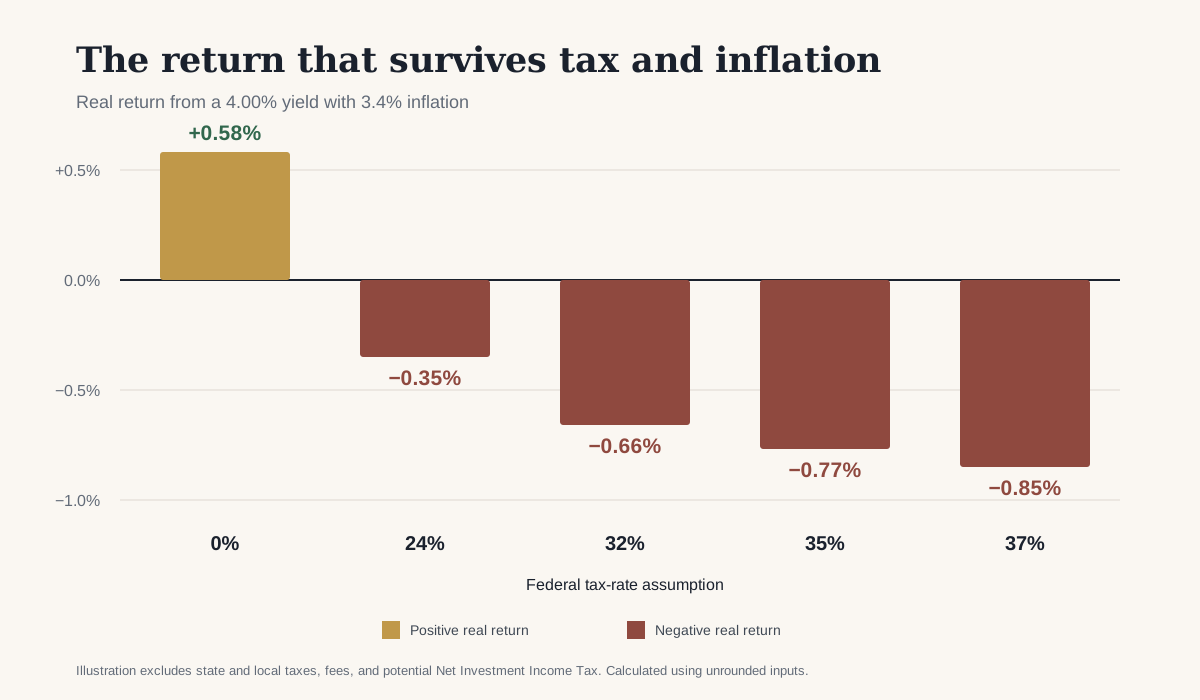
Suppose $100,000 earns 4.00% for one year. The headline result is straightforward: $4,000 of interest. But taxable interest is generally taxed as ordinary income at the federal level. If the interest is taxed at a 32% marginal federal rate, $1,280 goes to federal income tax and $2,720 remains.
Now compare the ending balance with 3.4% inflation. The precise calculation is:
At a 32% federal marginal rate, the 4.00% quoted yield becomes a 2.72% after-tax yield and an inflation-adjusted return of approximately −0.66%. The account balance is higher in dollars, but its purchasing power is lower by about $658.
| Federal tax-rate assumption | Gross interest | After-tax interest | After-tax yield | Real return after 3.4% inflation | Real gain / loss |
|---|---|---|---|---|---|
| 0% | $4,000 | $4,000 | 4.00% | +0.58% | +$580 |
| 24% | $4,000 | $3,040 | 3.04% | −0.35% | −$348 |
| 32% | $4,000 | $2,720 | 2.72% | −0.66% | −$658 |
| 35% | $4,000 | $2,600 | 2.60% | −0.77% | −$774 |
| 37% | $4,000 | $2,520 | 2.52% | −0.85% | −$851 |
Illustration only. Assumes a constant 4.00% annual yield, interest taxed at the selected federal marginal rate, and 3.4% inflation. It excludes state and local tax, fees, and the 3.8% Net Investment Income Tax, which may apply to some taxpayers. “Real gain / loss” is the change in purchasing power of $100,000, rounded to the nearest dollar. A marginal rate applies to the next dollar of taxable income—not to all income.
“Safe” has at least three meanings
Cash is often described as safe, but that word can obscure the actual decision. There are at least three forms of safety:
- Principal stability.Will the dollar amount be available when needed, without a large market loss?
- Liquidity.Can the money be accessed on the required date, without penalties, settlement delays, or selling at a disadvantage?
- Purchasing-power stability.Will the money retain enough real value to fund the goal?
Cash can perform exceptionally well on the first two and poorly on the third. That is not a flaw when the purpose is short term. It becomes a problem when money intended for a decade or more remains in cash by default.
The yield curve for cash is not flat
On September 25, 2026, Treasury bill coupon-equivalent yields ranged from 3.97% for four weeks to 4.48% for 52 weeks. Extending maturity offered more yield on that date, but it also meant committing funds for longer or accepting price risk if the bill had to be sold before maturity.
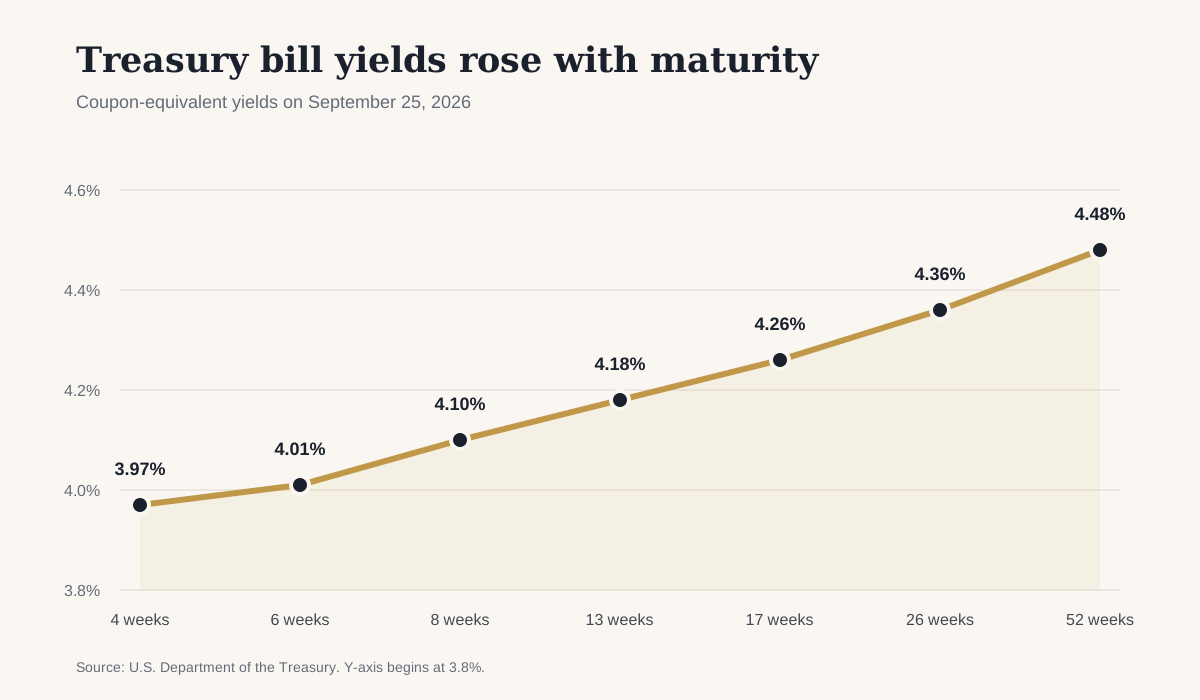
A higher yield is not automatically a better fit. The relevant comparison is the yield available for the period when the money can actually remain invested, adjusted for taxes, access needs, protection, and reinvestment risk.
Cash is a category, not a single product
“Cash” may refer to several vehicles with different protections, tax treatment, liquidity, and rate behavior. Those distinctions become important when balances are large or the money has a fixed deadline.
| Vehicle | Rate and access | Protection / structure | Tax note | Tradeoff to examine |
|---|---|---|---|---|
| High-yield savings | Variable rate; generally liquid | Deposit insurance may apply at an insured bank, subject to limits and ownership rules | Interest is generally taxable federally and by states | Promotional rates and transfer limits can change |
| Bank money market deposit account | Variable rate; access rules vary | Bank deposit; eligible for deposit insurance within applicable limits | Interest is generally taxable federally and by states | Do not confuse it with a money market mutual fund |
| Money market mutual fund | Yield changes with portfolio holdings; settlement and cutoff times vary | Security, not a bank deposit; not FDIC-insured and can lose value | Distributions are generally taxable; state treatment depends partly on holdings and reporting | Know whether the fund is government, prime, or tax-exempt |
| U.S. Treasury bill | Return set at purchase if held to maturity; maturities from 4 to 52 weeks | Direct obligation of the U.S. government; market value can change before maturity | Subject to federal income tax; exempt from state and local income taxes | Match maturity to the spending date and plan for reinvestment |
| Certificate of deposit | Often fixed for a stated term | Eligible deposits at insured banks may be covered within applicable limits | Interest is generally taxable as it is credited or becomes available | Early-withdrawal penalties; brokered CDs have additional considerations |
Insurance depends on the institution, account ownership category, and aggregate balances. FDIC coverage is generally at least $250,000 per depositor, per insured bank, for each ownership category. Confirm coverage and product terms directly rather than relying on a label in an app or brokerage interface.
Four quiet risks behind a large cash balance
Inflation risk
The balance may rise while its purchasing power falls. This is most consequential when a short-term holding becomes a long-term habit.
Tax drag
Ordinary interest can be less tax-efficient than the headline yield suggests, especially for higher earners and residents of high-tax states.
Reinvestment risk
Savings and money market rates can reset quickly. A maturing bill or CD may have to be reinvested at a lower rate.
Opportunity cost
Money held beyond its liquidity purpose may miss the long-term return potential of assets better aligned with distant goals.
Opportunity cost is not a prediction that stocks or bonds will outperform over the next month or year. It is a planning question: if money will not be needed for many years, is permanent liquidity valuable enough to justify a lower expected long-term return?
Give cash a job, then choose the vehicle
A more useful framework is to separate cash by purpose rather than treat every dollar alike.
Operating cash
Routine bills and near-term spending. Immediate access matters more than maximizing yield.
Resilience reserve
Unexpected expenses or income interruption. Size it around spending, job stability, insurance, family obligations, and access to other assets—not a generic rule alone.
Committed capital
Taxes, a home purchase, tuition, a business need, or another known goal in the next few years. Match the maturity and risk to the date of the obligation.
Long-term capital
Money with no foreseeable near-term use. Decide whether cash is an intentional allocation or simply a decision that has not been made.
A six-question cash review
Before moving money—or leaving it where it is—write down the answers to six questions:
- What specific job does this money have? If the answer is vague, the allocation probably is too.
- When is the earliest date it could be needed? Liquidity and maturity should follow the liability.
- What protection applies? Verify deposit-insurance limits, ownership categories, and whether the product is a deposit or a security.
- What is the after-tax yield? Include federal, state, local, and potentially Net Investment Income Tax consequences relevant to you.
- What happens when rates change? Understand when the yield resets or the security matures.
- What is the cost of keeping it in cash? For long-horizon money, compare the value of liquidity with the goal’s need for growth.
Sources and methodology
- Federal Reserve, FOMC statement (September 16, 2026).
- U.S. Department of the Treasury, Daily Treasury Bill Rates (September 25, 2026; coupon-equivalent yields).
- U.S. Bureau of Labor Statistics, Consumer Price Index—August 2026 (September 11, 2026).
- Investment Company Institute, Money Market Fund Assets (week ended September 23, 2026).
- Internal Revenue Service, 2026 federal tax brackets and Net Investment Income Tax.
- FDIC, Deposit Insurance; Investor.gov, Money Market Funds.
- TreasuryDirect, Tax Forms and Withholding; Consumer Financial Protection Bureau, Emergency Fund Guide.
CPI is an economy-wide average; a household’s experienced inflation can differ. Tax outcomes depend on the account, instrument, income, jurisdiction, and individual circumstances. All calculations were performed using unrounded inputs and rounded only for display.