
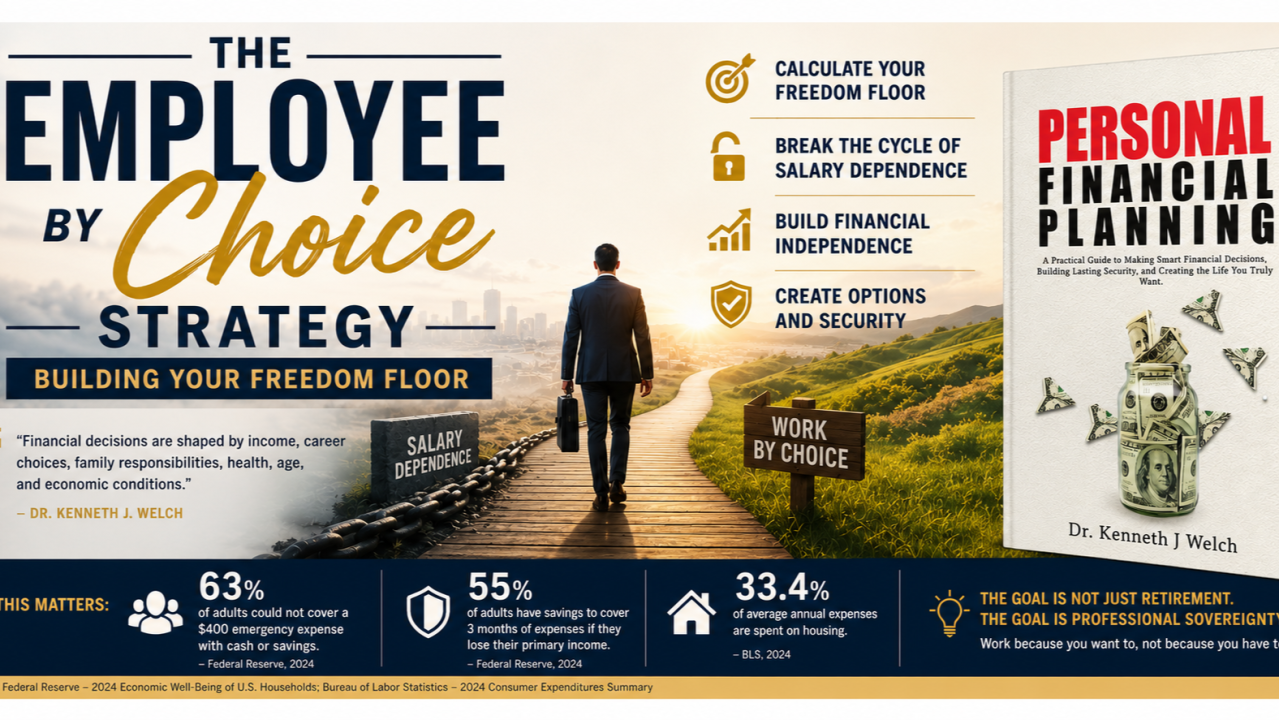
I recently read Personal Financial Planning by Dr. Kenneth J. Welch, and one idea strongly resonated with me: personal finance should be practical, realistic, and connected to real life, not just formulas and idealized scenarios.
The public description of the book says it is “written for real life, not idealized scenarios,” and that financial decisions are shaped by income, career choices, family responsibilities, health, age, and economic conditions. That is exactly how I think financial planning should work. It should not only answer, “Can I retire at 65?” It should also answer, “How can I live and work with more freedom today?”
This is where I believe highly educated professionals need a different conversation.
Many successful professionals are not poor. They are not careless. They are not financially uninformed.
But they are often corporate hostages.
Not because someone forced them to stay in a job, but because their lifestyle, mortgage, taxes, school expenses, debt, health insurance, and family obligations are tied to a salary they do not fully control.
A physician may want to reduce clinical hours but cannot.
An executive may want to leave a high-pressure role but feels trapped.
An attorney may want more autonomy but depends on partnership income.
A professor may want more flexibility but has not built enough outside resources.
A business professional may earn well but feel unable to take a strategic pause.
The problem is not always income.
The problem is the absence of a Freedom Floor.
What Is a Freedom Floor?
Your Freedom Floor is the minimum amount of financial capital required to make employment a choice rather than a necessity.
It is not the same as a traditional retirement number.
A retirement number asks:
“How much do I need to never work again?”
A Freedom Floor asks:
“How much do I need so I am no longer forced to stay in work I do not want, at a pace I cannot sustain, under conditions I do not control?”
This is a very different question.
For many educated professionals, the goal is not to stop working completely. Many still want to teach, consult, lead, serve, write, mentor, advise, build, or practice.
The goal is not “no work.”
The goal is work by choice.
Why This Matters Now
The financial data shows why this matters.
Even in a strong economy, many households lack financial resilience. The Federal Reserve’s 2024 household well-being report found that only 63% of adults could cover a $400 emergency expense with cash, savings, or a credit card paid off at the next statement. It also found that only 55% of adults had emergency savings to cover three months of expenses if they lost their primary income source. (Federal Reserve)
High income helps, but it does not automatically solve the problem. The Bureau of Labor Statistics reported that in 2024 average annual spending was $78,535 across all consumer units, but $150,342 for the highest income quintile. Housing was the largest spending category, representing 33.4% of average annual expenditures. (Bureau of Labor Statistics)
That matters because higher income often comes with higher fixed expenses.
- Bigger mortgage.
- Higher taxes.
- Private school.
- Cars.
- Travel.
- Professional image.
- Family support.
- Lifestyle expectations.
The result is a paradox:
A professional may have a high income but low freedom.
The Freedom Floor Formula
Here is a practical way to calculate your Freedom Floor.
Step 1: Calculate your essential annual spending
This includes:
- Housing
- Food
- Insurance
- Health care
- Taxes
- Debt payments
- Utilities
- Transportation
- Family obligations
- Basic lifestyle needs
This is not your luxury lifestyle number. This is your “life can continue with dignity” number.
Step 2: Subtract reliable non-employment income
Examples:
- Spouse income
- Rental income
- Pension income
- Business income not dependent on full-time work
- Investment income
- Consulting income you are confident you can generate
Step 3: Identify the annual gap
Formula:
Essential annual spending – reliable non-employment income = Freedom Gap
Step 4: Capitalize the gap
A simple planning shortcut is:
Freedom Gap × 25 = Approximate Freedom Floor
This uses a 4% starting point as a rough estimate, not a guarantee. The actual number depends on age, taxes, portfolio risk, inflation, health care, time horizon, and flexibility.
For a more conservative estimate:
Freedom Gap × 30 = More conservative Freedom Floor
Example: The High-Income Professional
Assume a professional household has:
- Essential annual spending: $180,000
- Reliable non-employment income: $60,000
- Annual Freedom Gap: $120,000
Using the 25x rule:
$120,000 × 25 = $3,000,000
Using the 30x rule:
$120,000 × 30 = $3,600,000
This does not mean they must retire today.
It means that somewhere in the $3.0 million to $3.6 million range of properly structured capital, their relationship with work changes.
They may not need to quit.
But they may no longer need to tolerate everything.
That is professional sovereignty.
The Freedom Floor Is Not Just One Number
Your Freedom Floor has layers.
1. Liquidity Floor
How many months could you live without your current paycheck?
For many professionals, this should be more than a generic emergency fund. If your income is specialized, variable, or tied to one employer, a 6–12-month liquidity reserve may be more appropriate.
2. Debt Floor
How much debt makes you fragile?
Large-fixed obligations can turn a high-income professional into a salary-dependent professional.
3. Insurance Floor
What risks could break the plan?
Disability insurance, life insurance, umbrella liability, malpractice coverage, and business protection may matter depending on your profession.
4. Investment Floor
How much diversified, accessible capital do you have outside your employer, business, or home equity?
Paper wealth is not always freedom if it is illiquid, concentrated, or tax trapped.
5. Career Optionality Floor
Can you earn income outside your current role?
Consulting, teaching, board work, writing, advisory work, part-time practice, and business ownership can all reduce dependence on one paycheck.
Build the Freedom Floor Before You Need It
This is where traditional financial planning becomes more powerful.
Do not wait until burnout, layoffs, illness, or organizational change forces a decision.
Build the Freedom Floor intentionally.
For 2026, the IRS allows employees to contribute $24,500 to many 401(k), 403(b), governmental 457 plans, and the federal Thrift Savings Plan; IRA contribution limits are $7,500, with higher catch-up amounts for eligible older workers. These limits are not the whole plan, but they are part of the system professionals can use to convert income into capital. (Internal Revenue Service)
A Freedom Floor strategy may include:
- Maximizing retirement plans when appropriate
- Building taxable investment accounts for flexibility
- Reducing high-interest debt
- Keeping fixed costs reasonable
- Building emergency reserves
- Protecting income with disability insurance
- Diversifying away from employer stock
- Creating tax-aware investment strategies
- Developing portable skills
- Creating secondary income channels
- Building a professional network before you need it
The goal is not simply to accumulate money.
The goal is to create options.
Why This Is Especially Important for Educated Professionals
Highly educated professionals often invest heavily in human capital.
- Degrees.
- Credentials.
- Training.
- Reputation.
- Professional identity.
But there is a risk: the more specialized you become, the more your income may depend on one system.
- One hospital.
- One university.
- One firm.
- One company.
- One partnership.
- One business.
- One industry.
That can create golden handcuffs.
The Freedom Floor breaks those handcuffs gradually.
It allows you to ask different questions:
Not just:
“Can I keep this job?”
But:
“Do I still want this job?”
Not just:
“Can I afford to retire?”
But:
“Can I afford to choose work that fits my life?”
Not just:
“How much do I earn?”
But:
“How much freedom is my income buying?”
The Final Takeaway
The highest value of money is not status.
It is freedom.
It is the ability to make decisions from strength instead of fear.
It is the ability to say:
“I can work here because I choose to, not because I have no other option.”
That is the heart of the Employee by Choice strategy.
Build your Freedom Floor.
Convert income into capital.
Keep lifestyle from absorbing every raise.
Protect your human capital.
Create liquidity.
Invest consistently.
Reduce dependence on one paycheck.
And use financial planning not only to retire someday, but to live and work with more freedom now.
The goal is not just retirement. The goal is professional sovereignty.