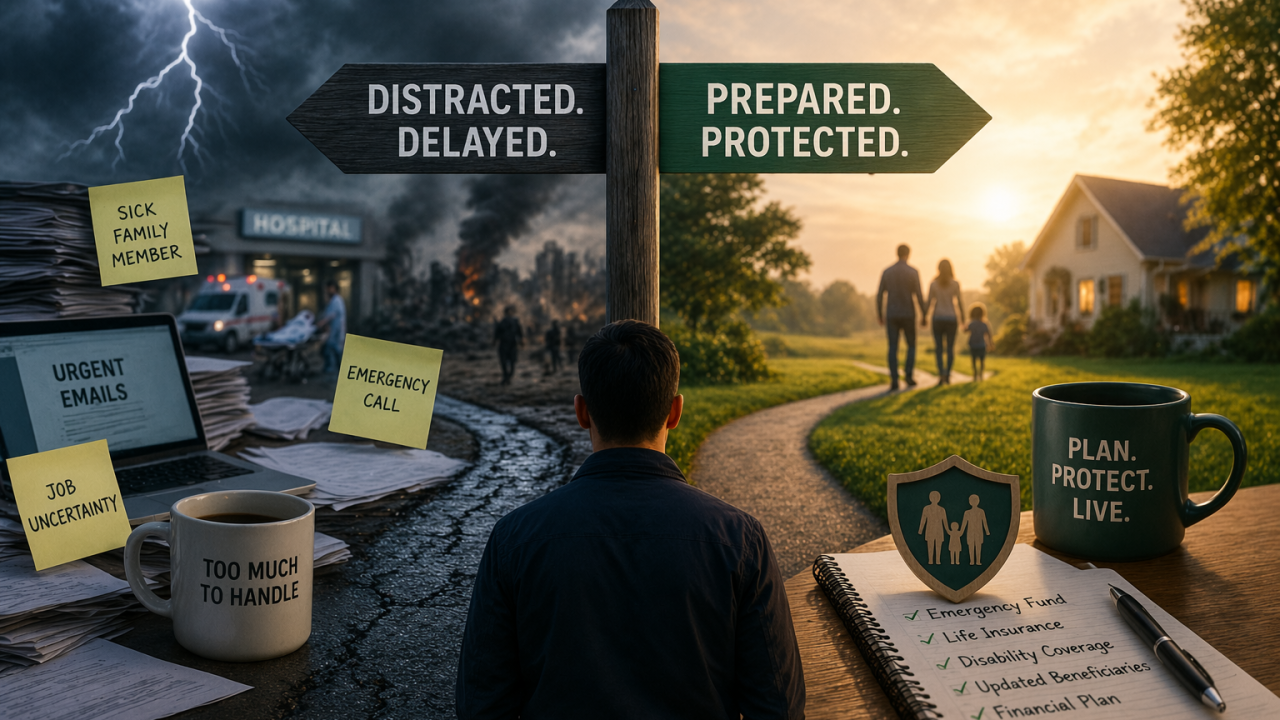
When a loved one gets sick, when your family is under pressure, when conflict touches the people you care about, or when work suddenly becomes uncertain, something very human happens: "We focus on the fire in front of us."
The bigger the crisis, the narrower our attention becomes. Stress does that. The CDC notes that stress can cause trouble concentrating and making decisions. In other words, the very moments when preparation matters most are often the moments when clear thinking becomes hardest.
As a financial consultant, I have seen this over and over again.
Clients do not usually pause the urgent things. They pause the things that feel less urgent. And sadly, financial planning is often first in line to be sacrificed.
The review gets delayed. The protection conversation gets postponed. The emergency fund gets pushed to “later.” The insurance application waits another month. The estate documents stay unfinished.
And yet these difficult seasons are not proof that planning can wait.
They are proof that planning matters.
A crisis should not only disturb us. It should also awaken us.
Because life does not only move in straight lines. It can turn suddenly. Illness. Job loss. Disability. Inflation. War. Family disruption. None of these risks are theoretical. They are part of the world we actually live in. UNHCR reported that 123.2 million people were forcibly displaced worldwide at the end of 2024 because of persecution, conflict, violence, human rights violations, or events seriously disturbing public order.
And even outside large-scale conflict, ordinary households live with instability more often than many people admit. The Federal Reserve reported that in 2024, 11% of U.S. adults struggled to pay bills because their income varied, and 23% had major, unexpected medical expenses in the prior 12 months. It also found that only 63% said they could cover a hypothetical $400 emergency expense with cash or its equivalent.
That is why these moments should not paralyze us.
They should clarify us.
They should remind us that financial planning is not a luxury for calm seasons. It is a stabilizer for unstable ones.
A real financial plan is not only about growth when markets are good. It is about resilience when life is not.
It asks questions like:
What happens if income stops for a while? What happens if a diagnosis changes everything? What happens if I need to support family during a crisis? What happens if I die too soon, or cannot work for longer than expected?
Those are not pessimistic questions. They are responsible questions.
And the risks are real. The Social Security Administration says about 1 in 4 of today’s 20-year-olds will become disabled before age 67, and 65% of the private-sector workforce has no long-term disability insurance. The Bureau of Labor Statistics also reported a 1.1% layoffs/discharges rate in February 2026, a reminder that employment can change quickly even when the broader labor market looks stable. (Social Security)
So, when life becomes turbulent, I believe we should resist one dangerous conclusion: “I’ll deal with planning later.”
Later is expensive. Later is uncertain. Later is often when options are fewer.
The hard season in front of us may feel like a reason to delay planning. In reality, it may be the clearest signal to take it seriously.
Not because we live in fear. But because we live in reality.
Preparation is how we protect dignity when life becomes unpredictable. Preparation is how we reduce panic when income is interrupted. Preparation is how we keep a family crisis from becoming a financial catastrophe.
So, if life has recently reminded you how fragile things can be, do not let that awareness become procrastination.
Let it become action.
Build the emergency fund. Review the protection plan. Look at disability coverage. Review life insurance. Update the beneficiaries. Revisit the budget. Put the structure in place while you still can.
Because difficult times are not only interruptions.
Sometimes, they are warnings. Sometimes, they are lessons. Sometimes, they are the wake-up call we were too busy to hear before.
And the right response is not paralysis.
It is preparation.