
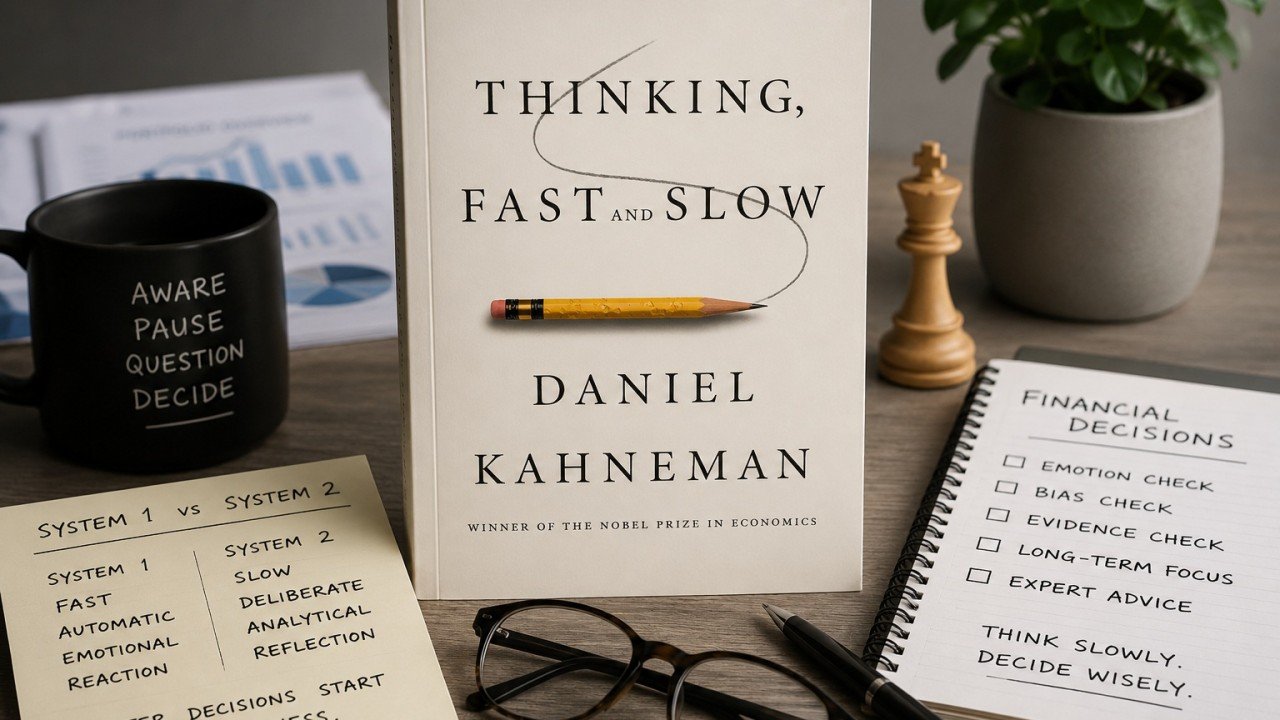
I recently read Thinking, Fast and Slow by Daniel Kahneman, and I found it extremely relevant to personal finance and financial planning. The book is not specifically a finance book, but it may be one of the most useful books for understanding why people make sub-optimal financial decisions.
As someone who has worked with many people and clients in financial decision-making, I have seen a common pattern: people often make poor choices not because they lack intelligence, but because they are influenced by predictable cognitive biases. These biases affect everyone. It does not matter how educated, successful, or smart a person is. When financial decisions are driven by fast, emotional, automatic thinking, even highly intelligent people can make mistakes.
Kahneman’s main idea is that the mind operates through two systems. System 1 is fast, automatic, intuitive, emotional, and effortless. System 2 is slower, more deliberate, analytical, and effortful. System 1 helps us move through life efficiently. It allows us to react quickly, recognize patterns, and make routine decisions without much effort. But System 1 also jumps to conclusions. It relies on shortcuts. It is easily influenced by emotion, framing, recent experiences, and first impressions.
System 2 is better suited for complex decisions, including financial planning. It can compare evidence, evaluate trade-offs, challenge assumptions, and slow down emotional reactions. But System 2 requires effort. Because it is mentally expensive, people often fail to activate it when they need it most.
This is why Thinking, Fast and Slow matters so much in personal finance. Money decisions are rarely just mathematical. They are emotional, psychological, and behavioral. A person may understand compound interest, diversification, insurance, taxes, or retirement planning, but still make a poor decision because a bias quietly takes control of the process.
Intelligence Does Not Eliminate Bias
One of the most important lessons from Kahneman’s work is that intelligence does not cancel out human cognition. Smart people can still be overconfident. Successful people can still anchor on the wrong number. Educated people can still panic during a market decline. Analytical people can still feel the pain of losses more strongly than the pleasure of gains.
The issue is not a lack of ability. The issue is that the human brain is designed to be efficient first, not perfectly accurate. System 1 is always working in the background, producing impressions, reactions, and quick judgments. Many of these judgments feel true before we have carefully examined them.
In financial planning, this can be dangerous because financial decisions often involve uncertainty, delayed consequences, and emotional pressure. A person may feel confident about buying a stock because it has recently performed well. A retiree may feel uncomfortable spending from a portfolio even when the plan supports it. An investor may sell during a downturn because recent losses feel unbearable. A family may underestimate future expenses because the current budget feels manageable.
These are not random mistakes. They are predictable mistakes.
Common Biases in Financial Decisions
Kahneman explains many cognitive biases that appear frequently in personal finance. One of the most common is anchoring. Anchoring occurs when the first number or idea we see shapes our later judgment. For example, an investor may anchor to the highest value their portfolio reached and feel that anything below that number is a loss, even if the portfolio has performed well over time.
A buyer may anchor to the listed price of a home or car and judge the deal relative to that number, even if the original price was unrealistic.
Another common bias is the availability heuristic. This happens when people judge the likelihood of an event based on how easily examples come to mind. If someone recently heard about a market crash, bank failure, or friend losing money in an investment, they may overestimate the probability of that outcome. On the other hand, if everyone around them seems to be making money in real estate, crypto, or a certain stock, they may underestimate the risk because success stories are more vivid and available.
Loss aversion is especially powerful in financial planning. Kahneman’s research shows that people tend to feel losses more intensely than equivalent gains. In practice, this means that losing $10,000 usually feels more painful than gaining $10,000 feels good. This can cause people to sell investments at the wrong time, avoid reasonable risk, hold losing investments too long, or become too conservative for their long-term goals.
The planning fallacy also appears often. People underestimate how long goals will take, how much projects will cost, or how difficult future obligations will be. A person may underestimate the cost of retirement, education, home repairs, health care, or starting a business. They may assume their income will rise smoothly, their expenses will stay stable, and their future self will save more later. The result is often delayed planning and unrealistic expectations.
Overconfidence may be the most dangerous bias of all. People often believe their judgments are more accurate than they really are. Investors may believe they can time the market. Business owners may underestimate risk. Professionals may assume their income is more secure than it is. Families may assume they can handle future expenses without a written plan. Overconfidence can make a person feel in control even when the decision is exposed to uncertainty.
Why System 1 Is Dangerous with Money
System 1 is not bad. In fact, it is necessary. We use it every day to make quick judgments and handle routine tasks. The problem is that System 1 is not designed for complex financial decisions.
Financial decisions often require time, discipline, probability, trade-offs, and long-term thinking. These are System 2 tasks. Deciding how much risk to take in a portfolio, whether to refinance debt, how much insurance to carry, when to retire, how to draw income from investments, or how to evaluate a tax strategy should not be handled by impulse or emotion.
Yet many financial decisions are made exactly that way. A market decline creates fear, and fear pushes action. A rising market creates excitement, and excitement pushes risk-taking. A sales presentation creates urgency, and urgency reduces careful analysis. A large purchase creates emotional attachment, and emotional attachment weakens objectivity.
When System 1 is in control, people often mistake feelings for facts.
Awareness Is the First Step
The first step toward better financial decision-making is awareness. A person must recognize that their first reaction may not be their best judgment. Feeling certain does not always mean being correct. Feeling afraid does not always mean danger is as high as it seems. Feeling excited does not always mean an opportunity is as good as it appears.
This awareness creates space between impulse and action. That space is where better decisions happen.
Before making an important financial decision, it is useful to pause and ask: Am I reacting emotionally? Am I relying on a recent example? Am I anchored to a number that may not matter? Am I afraid of a loss more than I am focused on the long-term plan? Am I overconfident? Am I seeing the full picture, or only the most vivid part of it?
These questions help activate System 2. They slow the process down and invite more deliberate thinking.
The Role of an Expert and Impartial Advisor
Because everyone is vulnerable to bias, one of the most valuable parts of financial planning is having access to expert and impartial guidance. A good financial advisor is not only there to calculate numbers or select investments. A good advisor also helps protect the decision-making process.
An impartial professional can help identify emotional reactions, challenge assumptions, stress test choices, and provide perspective when uncertainty is high. This is especially important during major life events such as retirement, job loss, inheritance, divorce, business sale, market volatility, or the death of a loved one. These are moments when System 1 can become especially powerful.
The value of advice is not only in knowing what to do. It is also in avoiding decisions that feel right in the moment but damage long-term financial well-being.
A strong advisor helps the client move from reaction to reflection. From emotion to evidence. From impulse to process.
Building a Better Financial Decision Process
The practical lesson from Thinking, Fast and Slow is not that we can eliminate bias completely. We cannot. The better goal is to build systems that reduce the damage biases can cause.
This can include creating a written financial plan, setting investment rules before market volatility occurs, using checklists for major decisions, reviewing assumptions regularly, and separating short-term emotions from long-term goals. It also means seeking a second opinion before making irreversible or high-stakes financial moves.
Good financial planning should make it harder to make bad decisions under pressure. The plan becomes a guardrail. It gives System 2 a structure to rely on before System 1 takes over.
For example, an investor who has already agreed on a long-term investment policy is less likely to panic during a downturn. A family with a written emergency plan is less likely to rely on credit cards during a crisis. A retiree with a clear withdrawal strategy is less likely to make spending decisions based only on market headlines. A business owner with an exit plan is less likely to make a rushed decision during stress.
Conclusion: Better Thinking Leads to Better Financial Decisions
Thinking, Fast and Slow is a powerful reminder that financial decision-making is not just about intelligence. It is about process. Even smart people make predictable mistakes when they rely too heavily on System 1. Fast thinking can be useful in everyday life, but personal finance often requires slow thinking.
The first step is to become aware of how we think. The second step is to create enough distance from our impulses to examine them. The third step is to use structure, planning, and impartial professional guidance to make better decisions.
In my experience, many sub-optimal financial decisions come from biases that people do not even realize are influencing them. That is why Kahneman’s message is so important. We cannot fully escape human psychology, but we can respect it, manage it, and design better decision-making systems around it.
The goal is not to become emotionless. The goal is to become more aware, more deliberate, and more disciplined. In personal finance, that difference can be life changing.