

For entrepreneurs in Canada and the U.S., corporate-owned whole life insurance is a premier tool for managing "lazy capital", retained earnings that would otherwise be subject to high passive investment taxes. Properly structured, these policies can provide planned liquidity at key moments, such as death, succession planning, or the triggering of buy-sell events.
1. The Advantages of Corporate Ownership
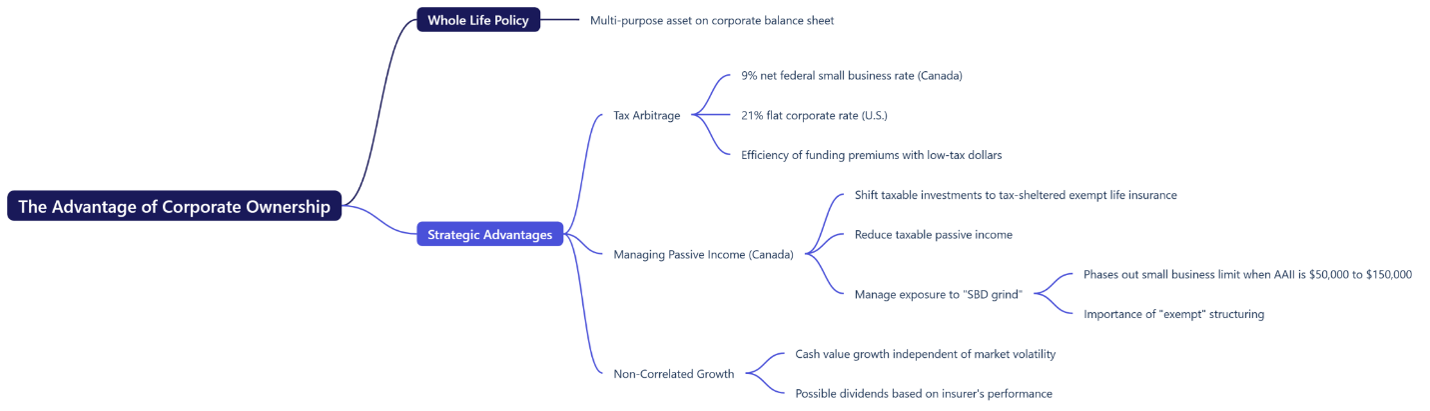
A whole life policy serves as a multi-purpose asset on the corporate balance sheet, offering several strategic advantages:
Tax Arbitrage: The 9% net federal small business rate for eligible CCPC (Canadian-Controlled Private Corporation) active business income in Canada and the 21% flat corporate rate in the U.S. are significantly lower than top personal rates. Funding premiums with these low-tax dollars is far more efficient than using personal after-tax income.
Managing Passive Income (Canada): Shifting taxable investments into a tax-sheltered exempt life insurance policy may help reduce taxable passive income and manage exposure to the "SBD grind," which phases out the small business limit when adjusted aggregate investment income (AAII) is between $50,000 and $150,000. Note that AAII can include income from savings in a life insurance policy that is not an exempt policy, which is why "exempt" structuring is vital.
Non-Correlated Growth: The policy’s cash value grows independently of market volatility and may receive dividends (not guaranteed) based on the insurer's performance and dividend scale.
2. The Canadian Framework – The Power of the CDA
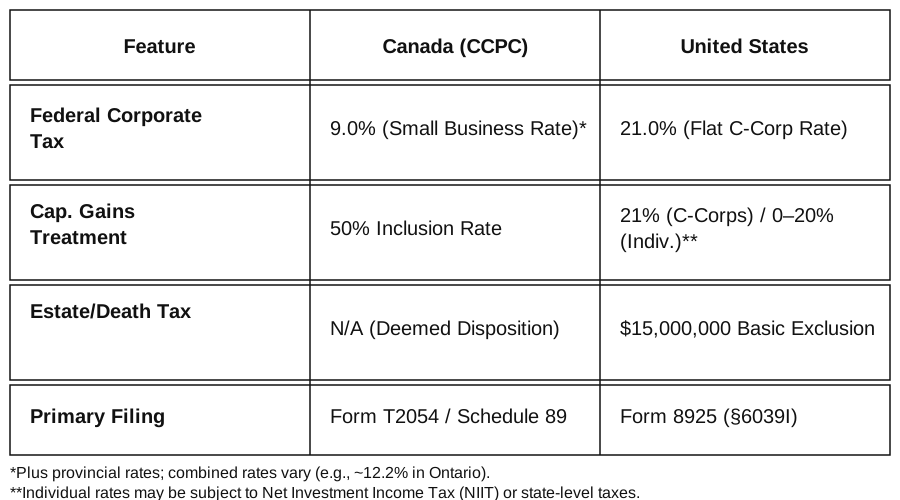
As of January 2026, the Canadian capital gains inclusion rate remains at 50% following the March 2025 cancellation of proposed hikes. This stability reinforces the value of the Capital Dividend Account (CDA), a notional account allowing private corporations to pay tax-free capital dividends to Canadian-resident shareholders.
Mechanism and Compliance
Under ITA 89(1), life insurance proceeds to the extent they exceed the policy's adjusted cost basis (ACB) are added to the CDA.
The §83(2) Election (Form T2054): To distribute funds tax-free, the corporation must file Form T2054 by the earlier of the day the dividend becomes payable and the first day any part of the dividend is paid.
Non-Resident Shareholders: Capital dividends paid to non-residents are subject to Part XIII withholding tax (though treaty reductions may apply).
Verification: Corporations may file T2SCH89 to request CRA verification of the CDA balance before making the election.
The Penalty Warning: Declaring a capital dividend that exceeds the actual CDA balance triggers a Part III tax penalty of 60% (3/5 of the excess) under ITA 184(2).
3. The U.S. Perspective – Exemption and COLI Compliance
The U.S. One Big Beautiful Bill (OBBB), enacted July 4, 2025, established a clearer framework for 2026 by setting high, inflation-indexed thresholds for estate and gift taxation.
2026 Estate and Gift Tax Limits
According to the IRS "What's New" Estate and Gift Tax guidance for 2026:
Basic Exclusion Amount (BEA): OBBB set the BEA at $15,000,000 per person for calendar year 2026 (unified for gift and estate taxes).
Annual Gift Exclusion: $19,000 per recipient.
Strategic Role: While the high exclusion protects many from federal tax, Corporate-Owned Life Insurance (COLI) is vital for funding buy-sell agreements and providing liquidity for state-level estate taxes.
Mandatory §101(j) Compliance
To preserve the income-tax exclusion of the death benefit under §101(a), employer-owned contracts must satisfy strict statutory requirements:
Notice and Consent: Under IRC §101(j), notice/consent must be completed before issue. An exception from the §101(j)(1) limitation may apply if (among other cases) the insured was (i) an employee at any time in the 12 months before death, or (ii) at issue was a director, a highly compensated employee (IRC §414(q)), or a highly compensated individual (IRC §105(h)(5), using 35%).
Reporting: Employers must report these contracts to the IRS under §6039I via Form 8925.
Risk: Non-compliance can cause the death proceeds (often the amount exceeding premiums paid) to become taxable income. IRS Notice 2009-48 provides canonical guidance for compliance.
4. The Immediate Financing Arrangement (IFA)
An IFA allows a corporation to secure permanent coverage without tying up the cash flow needed for active business operations.
The Leverage Strategy
The corporation pays the insurance premium and then borrows using the policy as collateral to reinvest in the business.
Canada (Interest Deductibility): Under ITA 20(1)(c), interest is only deductible if the borrowed money is directly traced to an income-earning business or property activity. The Act explicitly excludes borrowing to acquire a life insurance policy; thus, the loan must be documented as funding eligible business operations. (See CRA Folio S3-F6-C1).
U.S. (Restrictions): Under IRC §264, interest on debt incurred to carry life insurance on key persons is generally non-deductible. The strategy focuses on liquidity management and capital arbitrage.
Key Figures Summary
References
Canada Revenue Agency (CRA). Corporation Tax Rates. (January 2026).
Internal Revenue Service (IRS). What's new – Estate and gift tax. (Public Law 119-21, OBBB 2025).
Prime Minister of Canada. (March 21, 2025). Official Release: Prime Minister Carney cancels capital gains tax hike.
CRA Income Tax Folio S3-F2-C1. Capital Dividends. (Guidance on life insurance net proceeds in the CDA).
CRA Income Tax Folio S3-F6-C1. Interest Deductibility. (Guidance on tracing and §20(1)(c) exclusions).
Internal Revenue Service (IRS). Notice 2009-48: Employer-Owned Life Insurance Contracts.
Internal Revenue Service (IRS). About Form 8925, Report of Employer-Owned Life Insurance Contracts.
Department of Justice Canada. Income Tax Act, RSC 1985, c 1 (5th Supp). (Sections 83(2), 89(1), 184(2), 20(1)(c)).
IRS. Rev. Proc. 2025-32. (2026 Inflation Adjustments).