
Most privately held businesses don’t lose key people because they want to; people leave when the risk/reward math stops working for them.
And the business impact is real:
- Replacing an employee often costs far more than recruiting fees. Lost productivity, ramp-up time, customer disruption, team strain, and leadership distraction add up quickly. A review of multiple studies found a “typical” (median) turnover cost around ~21% of annual pay (with wide variation by role). (Center for American Progress)
- Even when “the labor market cools,” people still move. BLS (JOLTS) data shows that quits remain an ongoing reality that businesses must plan around. (Bureau of Labor Statistics)
So, the question becomes:
How do you create a real retention “anchor” for the people your business can’t afford to lose (without turning it into a complicated benefits project)?
One approach that works well is pairing a retention strategy (selective benefits / executive bonus concept) with key-employee life insurance protection, structured so it’s easy to implement, easy to explain, and aligned with business continuity needs.
Below is a practical walkthrough of how this can work using Symetra’s MultiLife Business Program, plus a realistic case example and a clear checklist of qualifications.
The concept
You identify a small group of “key employees” (owners, executives, senior managers, critical revenue producers). The business creates a selective benefit that:
- Rewards and retains key employees.
- Adds protection for the employee’s family and financial plan.
- Supports business objectives such as key-person exposure, ownership continuity planning, and attracting senior talent.
MultiLife’s unique angle is that if the group qualifies, underwriting is streamlined: eligibility is based on a short set of requirements and three simple questions (and for eligible employees, no medical exam is required).
What Symetra MultiLife is (and is not)

What it is
A business-focused program that can provide streamlined life insurance coverage for multiple key employees by having Symetra review the group case first and invite eligible employees to apply.
What it is not
It is not a guarantee that every employee will qualify or that a policy will be issued. Each employee is evaluated individually, and employees who don’t meet the program’s streamlined requirements may be handled through traditional/full underwriting instead.
Who qualifies
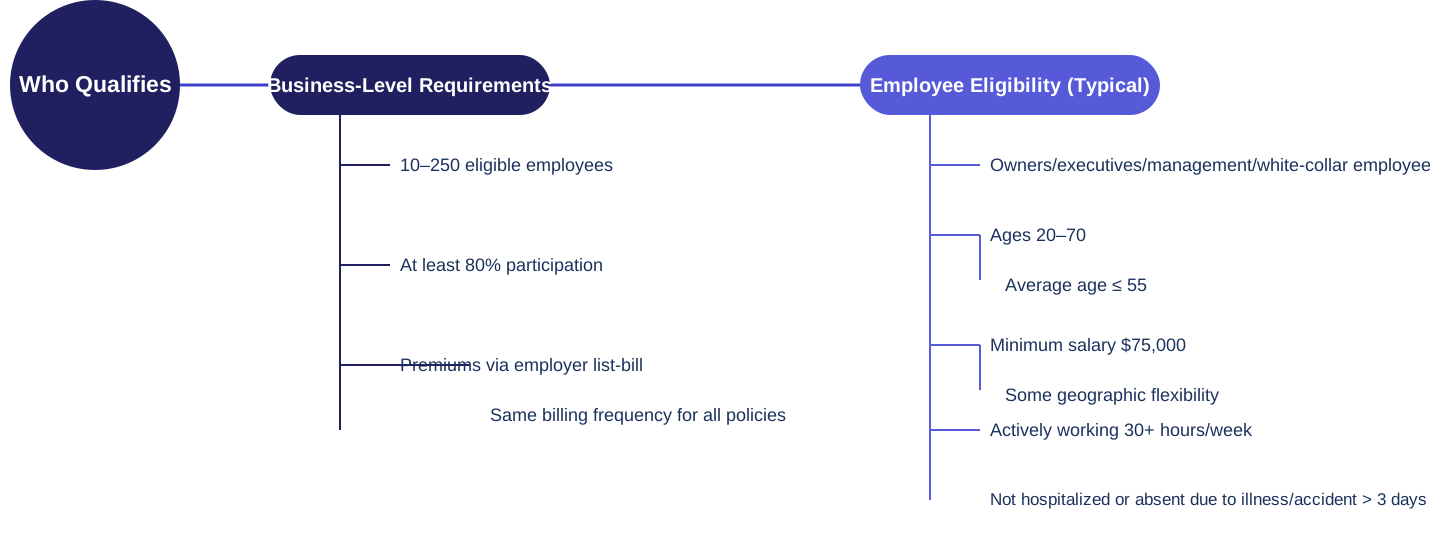
Business-level requirements (high level)
A business group generally must meet all of the following:
- 10–250 eligible employees (larger groups may be considered case-by-case).
- At least 80% participation of eligible employees.
- Premiums paid via employer list-bill, with the same billing frequency for all policies.
Employee eligibility (typical)
Eligible employees typically include:
- Owners/executives/management/white-collar employees
- Ages 20–70, and the eligible group’s average age must be 55 or younger
- Minimum salary $75,000 (some flexibility may apply by geography).
- Actively working 30+ hours/week
- Not hospitalized or absent due to illness/accident for more than 3 days in the last 3 months
Streamlined underwriting questions (for eligible employees)
Employees are asked:
- Hospitalized or absent due to illness/accident for more than 3 days in the last 3 months?
- Actively engaged in full-time work?
- Ever used tobacco/nicotine products?
If the answer is “no” to #1 and “yes” to #2, the employee is eligible for the program.
How the process actually works
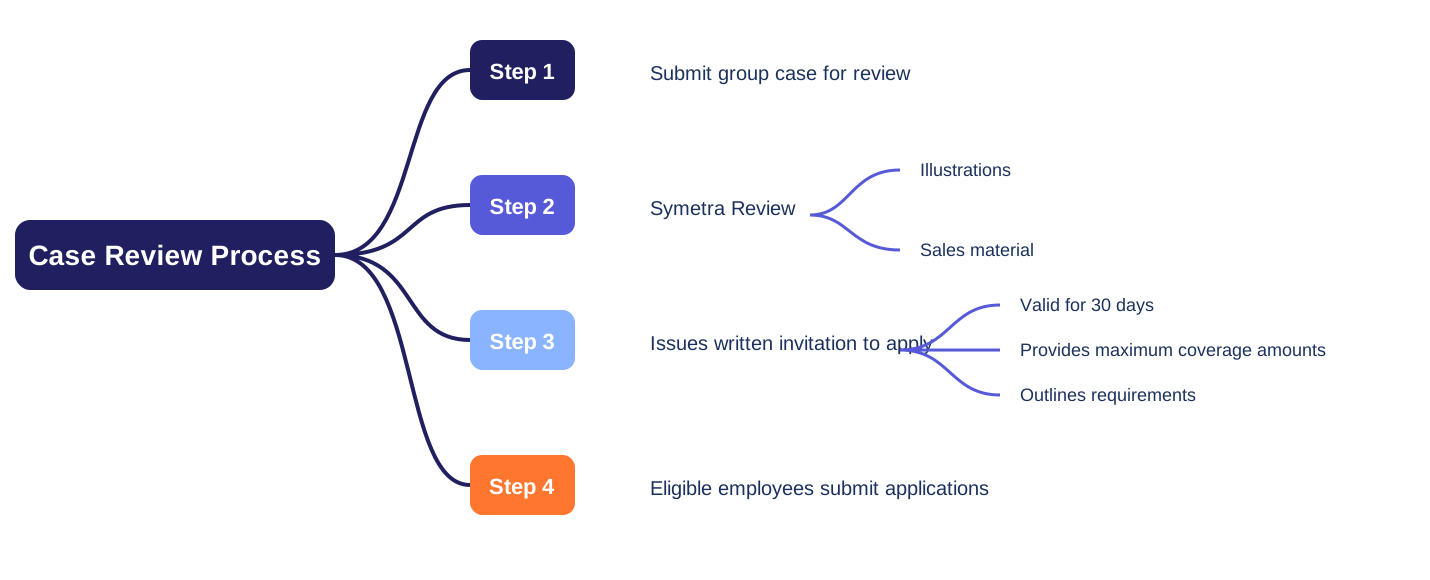
Process
- Submit the group case for review (before collecting individual applications).
- Symetra reviews and may request additional details (including sales material/illustrations).
- If approved, Symetra issues a written invitation to apply, valid for 30 days, and provides maximum coverage amounts and requirements.
- Then eligible employees submit their applications as a package.
After the group is established, new additions typically happen during a 60-day enrollment period aligned to the policy anniversary. Cases outside that window may go to full underwriting.
Case study: “The contractor who couldn’t afford to lose the project leaders”
Business profile
Privately held specialty construction firm (in SoCal)
Key leadership group (“key people”): owner, operations lead, estimator, two project managers, senior superintendent, finance lead, and key client-facing roles
Problem: competitor poaching + customer concentration risk + “If one PM leaves, jobs stall.”
What the owner wanted
- A meaningful retention benefit that senior people actually care about
- A program that doesn’t turn into a year-long HR implementation
- Predictable cost and a clean story to tell employees
Design approach
The company selects eligible key employees and uses a consistent benefit design (same structure across the group) to keep administration simple.
The business frames it as an executive retention investment: “We’re investing in you as a long-term leader here.”
How MultiLife helped
Because the group met program requirements (including participation and group criteria), the case could be submitted for Symetra’s group case review.
After approval, eligible employees used a streamlined underwriting path based on the three eligibility questions, reducing the friction that often slows or stops implementation.
Why this matters?
Retention isn’t only about compensation; it’s also about commitment signals. When a business creates a selective benefit for key people, it communicates:
- “You’re important here.”
- “We plan for continuity.”
- “Your family’s protection is part of our leadership culture.”
That signal matters in a labor market where quitting and job switching remain normal business conditions. (Bureau of Labor Statistics - JOLTS)
Business continuity angle (not just retention)
Many businesses also use key person insurance concepts to protect the company’s financial footing if an owner or core employee is lost, especially when lenders/investors care about the management team. (NerdWallet)
Where this fits: executive bonus / retention strategy
A common structure used in the marketplace is an “executive bonus” concept (often discussed under IRC Section 162), where the employer pays premiums as compensation/bonus to selected employees, and the employee owns the policy. (pacificguardian.com)
(Implementation details vary and should be reviewed with the company’s tax and legal advisors.)
Important tax guardrails
- IRC Section 162 is the general rule allowing deductions for ordinary and necessary business expenses, including reasonable compensation. (Justia Law)
- IRC Section 264 limits deductions for life insurance premiums when the taxpayer is directly or indirectly a beneficiary under the policy. (Legal Information Institute)
- IRC Section 101 is the general rule that life insurance proceeds paid by reason of death are excluded from gross income, with exceptions (e.g., transfer-for-value). (Legal Information Institute)
(This is just a big-picture overview, not a specific tax advice.)
How I support businesses (my role, start to finish)
I’m a business-focused financial advisor who partners with Symetra to help privately held companies retain key talent and reduce key-person risk.
At no cost for the consultation and preliminary screening, I provide:
1) Fit + qualification screening (fast “yes/no/maybe”)
- Confirm whether your group likely meets the program’s size and participation requirements (e.g., 10–250 eligible employees and 80% participation).
- Confirm whether key employees generally fit the role/age/salary/work status guidelines (e.g., owners/executives/management/white-collar; ages 20–70 with average age ≤55; typically, $75k+; actively working 30+ hours/week).
- Identify any exclusions that could make the case a non-starter.
2) Preliminary case design support
- Clarify the purpose: retention, key-person exposure, ownership continuity, or other executive benefit goals.
- Set a clean, consistent structure across the eligible group to simplify administration and rollout.
3) Submission + coordination
- Prepare and submit the group case materials for Symetra’s group case review (before collecting individual applications).
- Coordinate questions, requirements, and the invitation-to-apply window if the case is approved.
4) Application monitoring
- Track progress, keep stakeholders updated, and help maintain momentum through the enrollment period (including timing for new additions).
A quick “Is this worth a conversation?” checklist for business owners
This is usually a fit if you can say yes to most of the following:
- “We have 10+ key people we’d hate to lose.”
- “Those people are mostly W-2 leaders (owners/executives/management/white-collar), not contractors.”
- “We can get to strong participation among the eligible group (typically 80%+).”
- “Our key people generally fit the age/salary/work status profile (ages 20–70, average age ≤55, typically $75k+, actively working 30+ hours/week).”
- “We want a retention benefit that’s meaningful and practical to implement.”
References (non-exhaustive)
- Symetra MultiLife Business Program materials: eligibility requirements, streamlined underwriting questions, review/invitation process, enrollment timing, exclusions, and program uses.
- Center for American Progress: turnover cost synthesis (median ~21% of annual salary across many roles).
- U.S. Bureau of Labor Statistics (JOLTS / TED): quits rate and separations context.
- NerdWallet: overview and purpose of key person insurance for small businesses.
- IRC references: Section 162 (Justia), Section 264 (Cornell LII), Section 101 (Cornell LII).
- Pacific Guardian: executive bonus (IRC 162) concept overview and general mechanics.
Ali Talebi is a financial advisor and university professor who helps privately held businesses make smarter financial decisions, retain key employees, and reduce key-person risk. He has taught continuously since 2012 at leading Canadian and U.S. universities and delivers practical finance and management courses for business leaders. Based in Orange County (Laguna Hills), he brings a clear, education-first approach that makes complex decisions simple and actionable.