
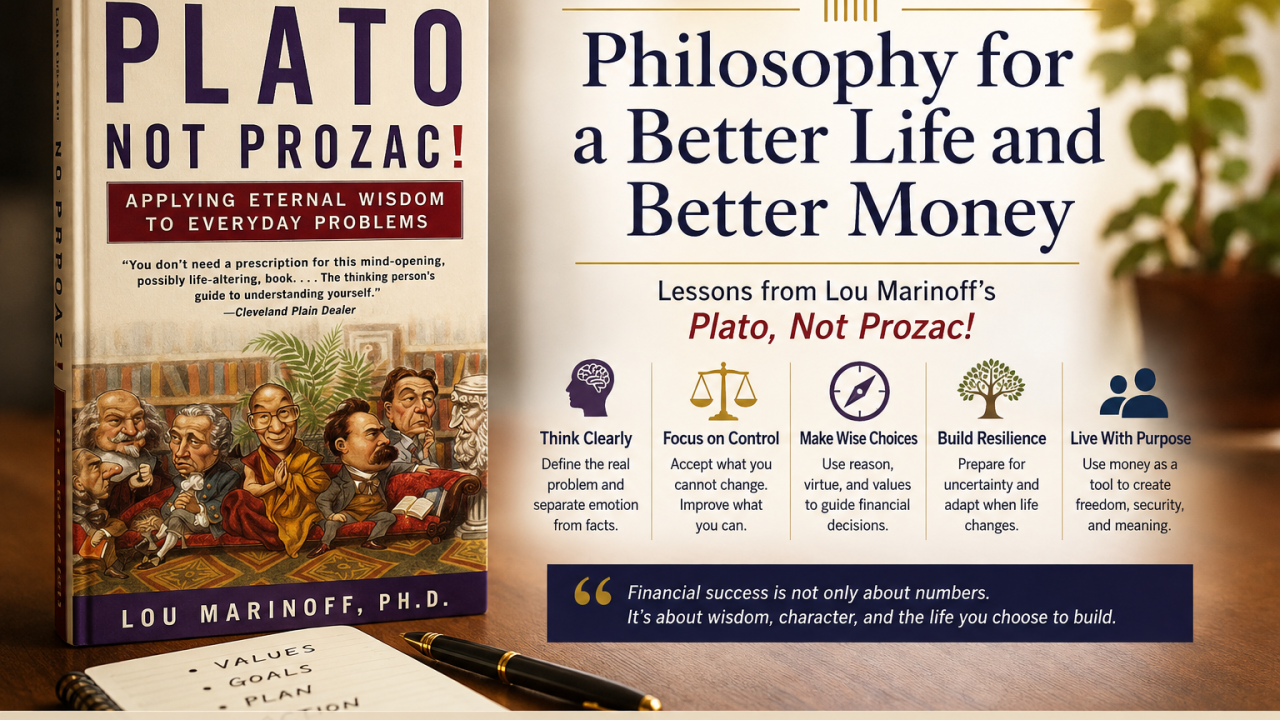
I recently read Lou Marinoff’s Plato, Not Prozac! and found it surprisingly relevant to personal finance.
It is not an investment book. It does not explain retirement accounts, taxes, insurance, or portfolio construction. Instead, it explores how philosophy can help us think through the ordinary, but often difficult, problems of life: uncertainty, anxiety, relationships, career dissatisfaction, ethical dilemmas, identity, and the search for happiness.
That connection matters because money is rarely just about numbers.
Personal finance touches almost every important part of life:
- Security
- Family
- Career
- Freedom
- Status
- Fear
- Responsibility
- Aging
- Generosity
- The future
Yet many people feel disconnected from their finances. They may be intelligent, highly educated, and successful in their careers, but financial language can still feel unfamiliar.
Asset allocation. Tax-loss harvesting. Sequence-of-returns risk. Roth conversions. Equity compensation. Beneficiary designations. Required minimum distributions.
The jargon creates distance. The complexity creates avoidance. Eventually, people may feel embarrassed that they do not understand something they believe they “should” already know.
But personal finance is too important to ignore.
The answer is not to pretend that financial planning is simple. Nor is it to avoid professional help. The better answer is to combine clear thinking, honest reflection, practical education, and qualified expertise.
That is where Marinoff’s philosophical approach becomes useful.
Philosophy Is Not Only Academic
Many people hear the word “philosophy” and imagine abstract debates in a university classroom.
Marinoff presents something much more practical.
Philosophy can help us ask:
- What is the real problem?
- Which emotions are affecting my judgment?
- What facts am I ignoring?
- What assumptions am I making?
- What can I control?
- What must I accept?
- What does a good decision look like?
- What kind of life am I trying to build?
These are philosophical questions, but they are also financial-planning questions.
When someone asks, “Should I retire?” the real issue may not be a retirement-account balance.
It may involve identity, purpose, fear, health, family expectations, and uncertainty about the future.
When someone asks, “Should I sell my company stock?” the answer is not only mathematical.
It may involve loyalty to an employer, overconfidence, fear of taxes, attachment to past gains, and anxiety about missing future growth.
When someone asks, “How much is enough?” no calculator can provide the complete answer.
That requires reflection about values, lifestyle, purpose, and contentment.
The PEACE Process
Marinoff organizes philosophical problem-solving through a five-step process called PEACE:
- Problem
- Emotion
- Analysis
- Contemplation
- Equilibrium
This framework can be applied directly to personal and financial decisions.
1. Problem: Define What Is Actually Wrong
People often describe financial problems too broadly:
“I am bad with money.”
“I will never be able to retire.”
“My financial life is a mess.”
“I am not as successful as I should be.”
These statements feel powerful, but they are not precise enough to solve.
A more useful definition might be:
“I do not currently know how much I need for retirement.”
“My spending has increased faster than my savings.”
“Too much of my net worth is tied to one company.”
“My spouse and I have not agreed on our financial priorities.”
“I have multiple accounts, but no coordinated plan.”
Clarity reduces helplessness.
A vague problem feels overwhelming. A specific problem can be examined.
2. Emotion: Recognize the Feeling Without Letting It Make the Decision
Money creates strong emotions:
- Fear during market declines
- Regret after missed opportunities
- Envy when others appear wealthier
- Shame about debt
- Anxiety about retirement
- Pride in company stock
- Excitement during market rallies
- Guilt about spending
- Pressure to support family members
The goal is not to eliminate emotion. Emotions carry information.
But emotion should not be mistaken for evidence.
Feeling frightened does not necessarily mean the financial plan is failing.
Feeling confident does not necessarily mean the investment is safe.
Feeling behind does not automatically mean you are behind.
The PEACE process encourages us to say:
“This is what I feel. Now let me examine what is actually true.”
That pause can prevent costly decisions.
3. Analysis: Examine the Facts and Alternatives
After separating the problem from the emotion, the next step is analysis.
In financial planning, that means asking:
- What are the relevant numbers?
- What assumptions are being used?
- What alternatives exist?
- What are the tax consequences?
- What could go wrong?
- How much liquidity is available?
- Is the decision reversible?
- What happens if I do nothing?
- Should another professional be involved?
Consider a client whose portfolio declines 25%.
Emotion may say:
“Sell before it gets worse.”
Analysis asks:
- Has the long-term plan changed?
- Is the portfolio properly diversified?
- Does the client need the money soon?
- Is the decline within the range considered during planning?
- Would selling create taxes or permanently lock in losses?
- Is rebalancing more appropriate than abandoning the plan?
Analysis does not guarantee certainty. It creates a better decision process.
4. Contemplation: Apply a Larger Philosophy
This is where Marinoff’s approach becomes especially powerful.
Facts alone do not tell us how to live.
At some point, we must decide which principles will guide us.
Several philosophical traditions are particularly relevant to personal finance.
Stoicism: Focus on What You Can Control
Stoicism teaches us to distinguish between what is within our control and what is not.
We cannot control:
- Market returns
- Interest-rate decisions
- Inflation
- Tax-law changes
- Recessions
- Employer decisions
- Other people’s opinions
- Unexpected life events
We can influence:
- Saving
- Spending
- Diversification
- Tax planning
- Insurance
- Emergency reserves
- Career development
- Estate planning
- Our response to volatility
- Whether we seek qualified advice
This distinction can be liberating.
Many people spend enormous emotional energy trying to predict markets while neglecting the financial decisions they can actually control.
A more Stoic planning question is:
“Given what I cannot control, what is the wisest action available to me now?”
Premeditatio Malorum: Prepare Before the Crisis
The Stoics practiced premeditatio malorum, the contemplation of possible adversity.
This was not pessimism. It was preparation.
In personal finance, it means stress-testing the plan before trouble arrives.
Ask:
- What would happen if the portfolio declined 30%?
- What if I lost my job?
- What if I became disabled?
- What if my spouse died?
- What if inflation remained high?
- What if I lived much longer than expected?
- What if my company stock fell while my employment was also at risk?
A good plan does not only show what happens when everything goes well.
It asks whether the household can remain stable when life becomes difficult.
The practical goal is to decide in advance:
“If the market falls, we will review the plan and rebalance, not panic and abandon it.”
A future crisis becomes less frightening when it has already been considered.
Amor Fati: Accept the New Reality and Choose the Next Best Step
Life does not always follow the original plan.
People experience:
- Layoffs
- Illness
- Divorce
- Business setbacks
- Market losses
- Family obligations
- Career changes
- Unexpected retirement
The Stoic idea of amor fati does not require us to enjoy hardship. It encourages us to stop arguing endlessly with reality.
In financial planning, that means:
“This is the situation now. What is the next best decision from here?”
A past decision may have been imperfect. A financial opportunity may have been missed. An investment may have fallen.
Regret cannot change the starting point.
It can, however, inform the next decision.
The View From Above: Expand the Time Horizon
Short-term events feel enormous when they fill our entire field of vision.
Marcus Aurelius used the idea of a “view from above”, stepping back mentally and seeing life from a broader perspective.
This is highly relevant to investing.
A market decline feels very different when viewed over:
- One week
- One year
- Thirty years
- A multigenerational family plan
The same principle applies to careers and financial progress.
One disappointing year does not define an entire professional life.
A temporary financial setback does not necessarily destroy a long-term plan.
The view from above asks:
“Will this event matter in ten or twenty years?”
And more importantly:
“What decision today will still look wise when viewed from that longer perspective?”
Aristotle: Find the Balanced Middle
Aristotle described virtue as the balanced point between extremes.
Courage lies between cowardice and recklessness.
This “Golden Mean” applies naturally to money.
Financial balance may lie between:
- Spending everything and never enjoying life
- Saving nothing and postponing all responsibility
- Taking no investment risk
- Taking excessive risk
- Giving nothing
- Giving beyond what is sustainable
- Working without rest
- Avoiding meaningful work
- Constantly upgrading lifestyle
- Denying every present pleasure
Good financial planning is rarely about maximizing one variable.
It is about balancing today and tomorrow, risk and security, generosity and responsibility, growth and protection.
Kant: Act With Integrity
Kant’s ethical framework asks us to consider whether we would be comfortable turning our action into a universal rule.
In finance, this provides a powerful test.
Would we want every advisor to:
- Disclose fees clearly?
- Explain conflicts of interest?
- Admit uncertainty?
- Recommend only what serves the client?
- Avoid exaggerating expected returns?
- Respect client confidentiality?
- Explain risks as clearly as benefits?
If the answer is yes, those principles should guide our own behavior.
For financial professionals, philosophy is not merely about helping clients stay calm. It is also a fiduciary compass.
The Four Stoic Virtues in Personal Finance
The traditional Stoic virtues translate well into financial planning.
Wisdom
Use evidence, realistic assumptions, and disciplined planning rather than speculation and market predictions.
Courage
Have necessary conversations about spending, debt, retirement readiness, family support, insurance gaps, and unrealistic expectations.
Justice
Be transparent about fees, conflicts, responsibilities, and the limits of advice.
Temperance
Avoid lifestyle inflation, excessive risk, emotional spending, and the endless movement of the “enough” goalpost.
Together, these virtues create something more valuable than financial sophistication.
They create financial character.
A Philosophical Financial Discovery Process
Traditional risk questionnaires may ask:
“How would you react if your portfolio declined by 20%?”
But people do not always know how they will behave until the decline happens alongside frightening headlines, job uncertainty, and family pressure.
A philosophical conversation can go deeper.
The Dichotomy of Control
“When you think about inflation, interest rates, and market volatility, what worries you most?”
Then ask:
“Which parts of that situation can you meaningfully influence?”
This reveals whether the client is focused on external predictions or controllable behavior.
Preparing for Adversity
“Imagine that your portfolio declines 30% during a recession. What would you feel, and what would you expect your advisor to do?”
“If your income stopped unexpectedly, how long could your family maintain its lifestyle?”
These questions reveal emotional and financial resilience.
The View From Above
“What is the ultimate purpose of this money?”
Possible answers may include:
- Retirement independence
- Family security
- Education
- Charitable impact
- Freedom from an unwanted career
- A legacy
- Peace of mind
This changes the conversation from outperforming an index to fulfilling a purpose.
Temperance and Enough
“As your income has increased, how has your definition of a comfortable life changed?”
“How will you know when you have enough?”
These may be among the most important questions in financial planning.
Without a definition of enough, every financial milestone becomes temporary.
The target keeps moving.
Why Expert Guidance Still Matters
Philosophy helps us ask better questions. It does not replace technical expertise.
A philosophical framework will not calculate:
- The tax consequences of an ISO exercise
- The appropriate amount of disability insurance
- A sustainable retirement withdrawal strategy
- A Roth-conversion schedule
- The effect of pension elections
- Estate-planning requirements
- Portfolio risk
- The interaction of employer benefits
Similarly, reading about medicine does not replace a physician, and reading about law does not replace an attorney.
Personal finance should not be ignored simply because the language feels unfamiliar.
The solution is not shame. It is education and support.
A qualified financial planner can help translate complexity into understandable decisions. A CPA can evaluate tax consequences. An estate attorney can provide legal guidance. An insurance professional can help transfer risks appropriately.
The client does not need to become an expert in every field.
But the client should understand enough to participate meaningfully in the decisions.
Good advice should make people more informed, not more dependent.
Philosophy and Personal Finance Share the Same Goal
At their best, philosophy and financial planning are both concerned with the same question:
How should we live?
Money is part of that question, but not the whole answer.
A financial plan should help us:
- Protect the people we love
- Use resources responsibly
- Prepare for uncertainty
- Create freedom
- Support meaningful work
- Avoid preventable mistakes
- Give thoughtfully
- Enjoy life without sacrificing the future
- Define what enough means
The goal is not simply to accumulate more.
It is to use money wisely in service of a life worth living.
A Practical PEACE Exercise for Your Financial Life
Choose one financial concern and work through these questions:
Problem
What is the precise issue?
Emotion
What feelings does it create?
Analysis
What are the facts, alternatives, risks, and consequences?
Contemplation
Which principles should guide the decision?
Equilibrium
What balanced action can you take now?
For example:
Problem: I am uncertain whether I can retire.
Emotion: Fear, excitement, and concern about losing professional identity.
Analysis: Review spending, income, taxes, healthcare, portfolio sustainability, and alternative work arrangements.
Contemplation: What does a meaningful next chapter look like? How much security is enough? What parts of work do I want to preserve?
Equilibrium: Build a phased retirement plan, strengthen reserves, test the numbers, and make the transition deliberately rather than reactively.
That is philosophy becoming practical.
Final Thought
Plato, Not Prozac! reminded me that many of our most difficult problems cannot be solved through data alone.
We need numbers, but we also need meaning.
We need analysis, but we also need judgment.
We need professional expertise, but we also need self-knowledge.
And when it comes to personal finance, we need to stop treating confusion as a reason to disengage.
Money may be complicated. The terminology may feel unfamiliar. The future may remain uncertain.
But those are reasons to ask better questions, seek appropriate guidance, and participate more actively, not reasons to look away.
Financial planning is not only about managing money. It is about thinking clearly, acting wisely, preparing courageously, and using our resources to build a more meaningful life.
Philosophy can help us understand what matters. Financial planning can help us put it into action.