
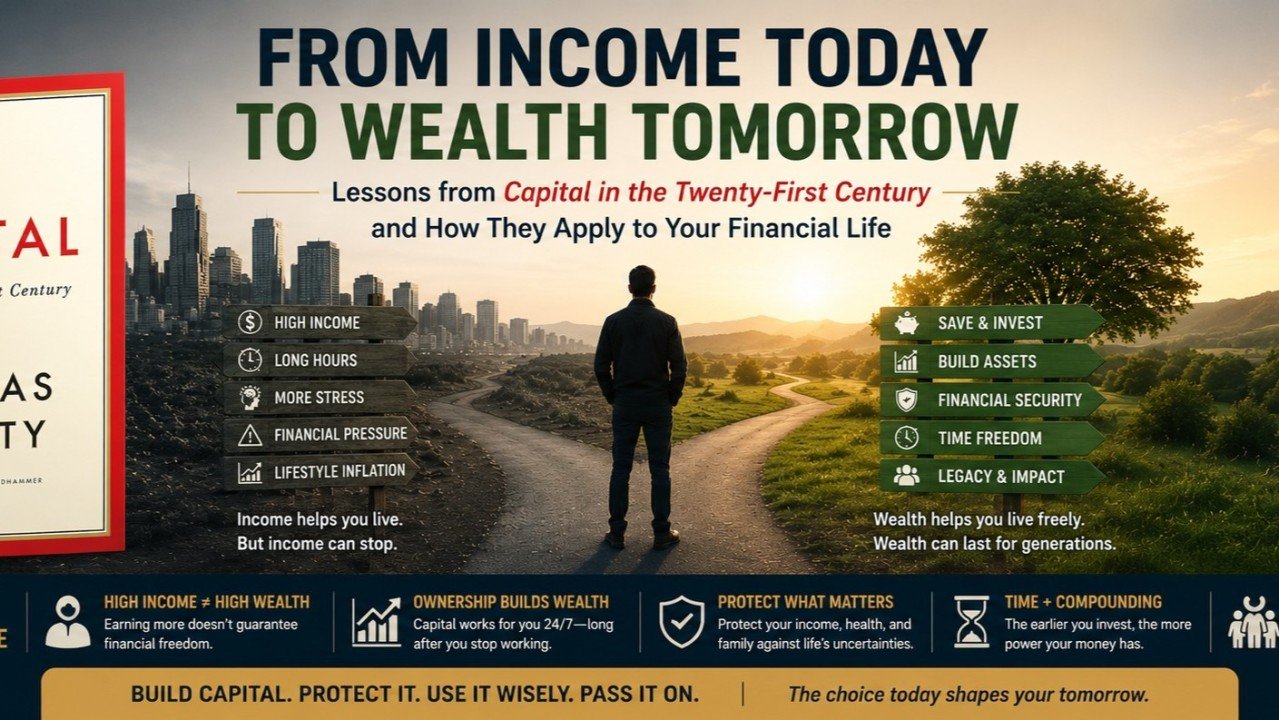
I recently read Capital in the Twenty-First Century by Thomas Piketty, and I realized how relevant and important this book is for personal finance and financial planning.
At first glance, this may not look like a personal finance book. It is a major work about capital, income, inequality, inheritance, and economic history. But the more I reflected on it, the more I saw a very practical lesson for individuals and families:
High income does not automatically lead to high wealth.
This is one of the most important financial truths that many successful professionals need to understand. Piketty’s central idea is often summarized as: r > g
In simple terms, when the return on capital is greater than the growth rate of the economy, people who own capital tend to build wealth faster than people who rely only on labor income. For personal finance, this means something very practical:
Your salary helps you live. Your capital helps you become financially free.
Income is what you earn. Wealth is what you keep and build.
Many highly educated professionals earn strong incomes. Physicians, dentists, attorneys, engineers, executives, professors, business owners, and consultants may have impressive salaries or business income. But income alone is not wealth.
Income can disappear.
A job can be lost. A business can slow down. A health problem can interrupt work. A family responsibility can reduce earning capacity. A recession can reduce bonuses, clients, or opportunities. A profession can change because of technology, regulation, or market forces.
This is why financial planning cannot only focus on income. It must focus on converting income into durable wealth.
The real question is not only:
“How much do I make?”
The better question is:
“How much of my income becomes capital?”
Capital includes investments, retirement accounts, real estate equity, business ownership, taxable brokerage assets, cash reserves, and other productive assets that can support your life even when your active income slows down or stops.
High income can hide financial fragility.
I have seen this fact many times in real life. Someone earns a high income, but almost all of it goes to mortgage payments, car payments, private school, travel, lifestyle expenses, taxes, debt, and family support.
On the outside, the person looks successful. But financially, they may have very little flexibility. This is the difference between looking wealthy and being wealthy. A high-income household can still be fragile if it has:
- Low savings
- High fixed expenses
- Too much debt
- No emergency fund
- No disability protection
- No estate plan
- Too much concentration in one employer, business, or property
- Too little investment discipline
- Too much lifestyle inflation
A strong income is valuable, but it is not enough. Without planning, income can become consumption instead of capital.
Wealth gives you options.
The real power of wealth is not only luxury. It is freedom. Wealth can give you the ability to:
- Leave a toxic job
- Retire with dignity
- Help family responsibly
- Start a business
- Reduce stress
- Survive a health issue
- Handle market volatility
- Support children’s education
- Take care of aging parents
- Give to causes you care about
- Make decisions from strength instead of fear
That is why wealth accumulation matters. It is not about greed. It is about security, independence, dignity, and choice.
We must protect income while we are building wealth.
Another lesson from this book is that labor income is powerful, but it is also vulnerable. For many professionals, their greatest asset is not their portfolio. It is their ability to earn income over time. That means protecting income is essential. A comprehensive financial plan should consider:
- Emergency reserves
- Disability insurance
- Life insurance, when others depend on your income
- Health insurance
- Liability protection
- Debt management
- Career flexibility
- Professional skills
- Business continuity
- Diversified investments
We cannot assume we will always be able to generate the same level of income forever. This is especially important for professionals whose lifestyle, mortgage, retirement goals, and family obligations depend heavily on ongoing income.
Education creates human capital. Planning converts it into financial capital.
As someone with a background in business, finance, and financial planning, I believe education is one of the most powerful investments a person can make. But education alone does not guarantee wealth. A degree can help create income. A profession can help create opportunity. A business can help create cash flow.
But financial planning is what helps convert that income into lasting capital. That requires:
- Saving consistently
- Investing intelligently
- Managing taxes
- Protecting against major risks
- Avoiding lifestyle inflation
- Building diversified assets
- Planning for retirement
- Reviewing estate documents and beneficiaries
- Coordinating with CPAs and attorneys
- Making decisions with discipline instead of emotion
This is where comprehensive financial planning becomes so important.
The goal is to move from labor income to capital strength.
A useful way to think about personal finance is this:
- Earn. Build human capital and generate income.
- Save. Create a gap between income and spending.
- Invest. Convert savings into productive assets.
- Protect. Use insurance, liquidity, diversification, and estate planning.
- Optimize. Improve taxes, asset location, and withdrawal strategies.
- Transfer. Pass wealth responsibly through planning and education.
This is the path from income to wealth. And for many educated professionals, this is the missing bridge. They worked hard to build credentials, careers, and income. But the next step is to build capital, protect it, and use it wisely.
Some practical questions to ask yourself
Here are a few questions worth reflecting on:
- Am I building wealth, or mainly funding a lifestyle?
- What percentage of my income becomes long-term capital?
- If my income stopped for six months, what would happen?
- Do I have enough liquidity?
- Is my family protected if I cannot work?
- Am I too dependent on one employer, business, property, or investment?
- Is my investment strategy tax-aware?
- Do I have an estate plan and updated beneficiaries?
- Am I measuring net worth, or only income?
- What does financial freedom actually mean to me?
Answering these questions are not always easy, but they are necessary.
Final thought
Reading Capital in the Twenty-First Century reminded me that personal finance is not only about budgeting, investing, or retirement projections. It is about understanding the difference between income and capital. Income is important. But income alone is not enough.
We need to build wealth. We need to protect our income. We need to invest intentionally. We need to manage taxes. We need to protect our families. We need to prepare for the day when we cannot, or do not want to, rely only on active work. For me, the practical lesson is simple:
Your income supports your lifestyle today. Your capital supports your freedom tomorrow.
That is why comprehensive financial planning matters.