
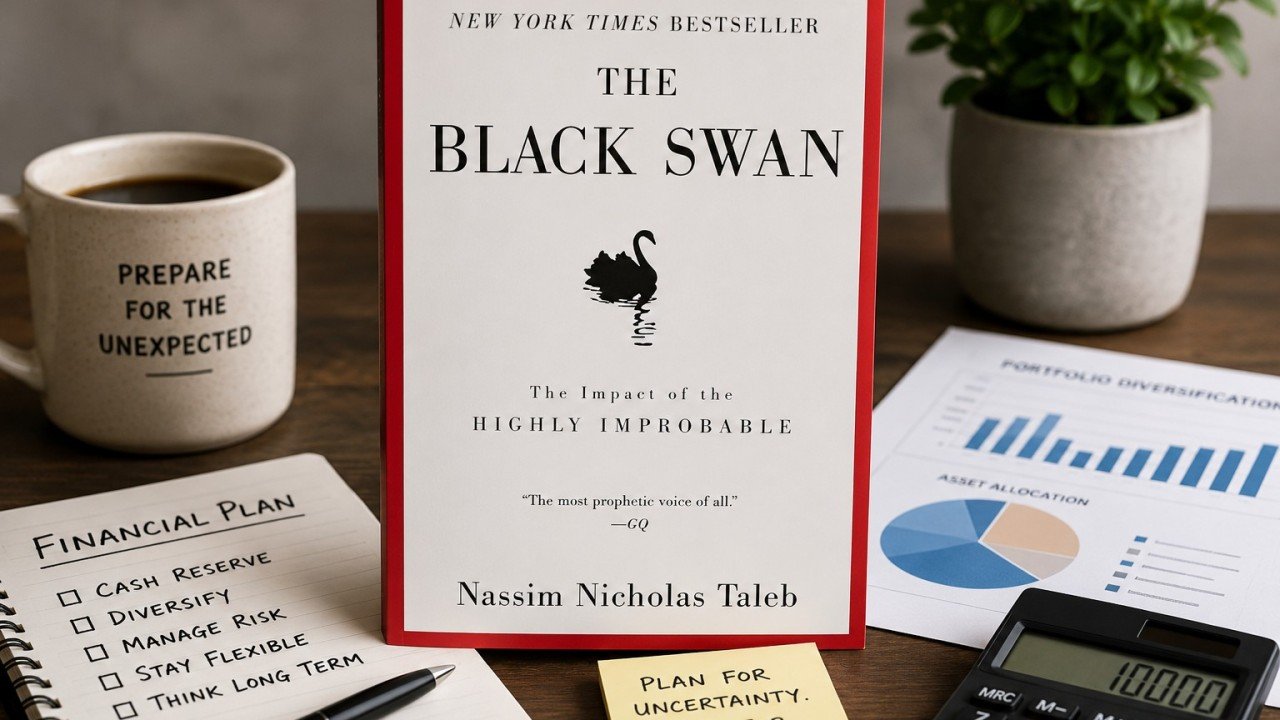
I recently read The Black Swan: The Impact of the Highly Improbable by Nassim Nicholas Taleb, and I found it highly relevant to the world of personal finance and financial planning. Although the book is often discussed in the context of markets, risk, probability, and forecasting, its lessons go far beyond investing. For anyone trying to build financial security, plan for retirement, protect a family, or make better life decisions, The Black Swan offers an important reminder: the events that shape our financial lives are often the ones we did not predict.
Taleb’s central argument is that many of the most important events in history, markets, careers, and personal lives are not small, predictable variations around an average. They are rare, high-impact shocks that sit outside normal expectations. He calls these events “Black Swans.” A Black Swan is an event that seems highly improbable beforehand, has massive consequences when it occurs, and is often explained afterward as if it should have been obvious all along.
This idea is deeply connected to personal finance. Traditional financial planning often relies on assumptions: expected investment returns, inflation rates, retirement ages, income growth, tax rules, life expectancy, and spending patterns. These assumptions are useful, but Taleb’s message warns us not to confuse a model with reality. Life does not always move in a straight line. A sudden job loss, health crisis, market crash, divorce, lawsuit, business opportunity, technological shift, or family emergency can change a financial plan more than years of normal savings and investment growth.
That does not mean financial planning is useless. In fact, it means good financial planning is even more important. But the goal should not be to predict the future perfectly. The goal should be to build a financial life that is robust enough to survive negative surprises and flexible enough to benefit from positive surprises.
The Danger of Overconfidence in Forecasts
One of the most important lessons from The Black Swan is that people often trust forecasts too much. We like clean projections, smooth charts, and confident explanations. In personal finance, this can show up in many ways: assuming the stock market will provide average returns every year, assuming income will continue uninterrupted, assuming expenses will stay predictable, or assuming retirement will happen exactly on schedule.
The problem is not that assumptions are always wrong. The problem is that assumptions can create false confidence. A retirement projection may show that a client is “on track,” but what happens if the market drops 35% right before retirement? What happens if inflation stays higher than expected? What happens if a client has to retire earlier than planned due to health or employment issues? What happens if adult children or aging parents require financial support?
A plan that only works under ideal conditions is not a strong plan. Taleb’s thinking encourages financial planners and individuals to ask a better question: “What happens if we are wrong?”
Stress Testing the Financial Plan
A Black Swan mindset shifts the focus from prediction to preparation. Instead of asking only, “What do I think will happen?” a better financial planning question is, “What would happen if something unexpected occurs?”
This is where stress testing becomes essential. A strong financial plan should be tested against difficult scenarios: a major market decline, job interruption, emergency expense, disability, premature death, long-term care need, business failure, or unexpected tax change. If one surprise can destroy the entire plan, then the plan is too fragile.
Stress testing does not eliminate uncertainty, but it reveals weak points. It helps identify whether a family has enough emergency savings, adequate insurance, manageable debt, diversified investments, and flexible spending. It also encourages more realistic conversations about risk. The purpose is not to scare people. The purpose is to make them harder to break.
The Importance of Avoiding Ruin
A major takeaway from Taleb’s work is that survival matters. In personal finance, this means avoiding decisions that can cause permanent damage. The first rule is not to maximize returns at all costs. The first rule is to avoid financial ruin.
This has practical implications. Excessive leverage can be dangerous because one unexpected downturn can wipe out years of progress. Concentrating too much wealth in one stock, one employer, one business, or one asset class can create hidden fragility. Living without cash reserves may look efficient during stable times, but it becomes dangerous when life becomes unpredictable.
A good financial plan should protect against catastrophic downside. This includes maintaining an emergency fund, having appropriate insurance, avoiding unsustainable debt, diversifying investments, and keeping enough liquidity to handle disruption. These choices may not always look exciting, but they create resilience.
In a Black Swan world, the boring parts of financial planning are often the most powerful.
The Barbell Strategy in Personal Finance
One of Taleb’s most practical ideas is the “barbell strategy.” In simple terms, this means keeping most of your resources in very safe, durable positions while using a smaller portion for high-upside opportunities with limited downside. The goal is to avoid the fragile middle: taking meaningful risk without meaningful upside.
In personal finance, this can be applied in several ways. A family might keep a strong cash reserve, stable insurance coverage, and a diversified long-term investment portfolio, while also allocating a small amount of time or money toward entrepreneurial projects, career development, or carefully limited speculative investments. The key is that the risky side of the barbell should not be large enough to destroy the plan if it fails.
This approach is not about gambling. It is about combining safety with optionality. A person should be protected from disaster while still leaving room for unexpected positive outcomes. That could mean learning a new skill, starting a side business, building a professional network, or making a small investment in an emerging opportunity. The downside is limited, but the upside may be significant.
Building Slack into Financial Life
Modern life often rewards efficiency. People try to optimize every dollar, every hour, and every investment decision. But Taleb’s work suggests that too much optimization can create fragility. A life with no financial cushion, no free time, and no backup plan may look efficient, but it can break quickly under stress.
In personal finance, slack is not waste. Slack is protection.
Cash reserves, flexible spending, manageable fixed expenses, available credit, transferable skills, and open calendar space all create room to respond. They allow a person to absorb shocks and take advantage of opportunities. Without slack, even a small emergency can become a crisis. With slack, a person has choices.
For example, an emergency fund may seem inefficient when markets are rising. But when a job loss or medical expense occurs, that same fund becomes priceless. Similarly, keeping debt payments manageable may feel conservative, but it creates flexibility during uncertain times.
Optionality: Preparing for Positive Black Swans
The Black Swan concept is not only about avoiding bad surprises. It is also about positioning yourself for good surprises. In financial planning, this means creating optionality.
Optionality means having choices. A person with savings has more choices than a person living paycheck to paycheck. A person with portable skills has more choices than someone dependent on one employer. A person with a strong network has more choices than someone professionally isolated. A person with low fixed expenses has more choices than someone locked into heavy financial commitments.
Positive Black Swans often come from being prepared when an unexpected opportunity appears. A business idea, investment opportunity, career change, relocation, partnership, or personal connection may not be predictable. But a person can be financially and mentally ready to act when it appears.
This is why financial planning should not be just defensive. It should also create flexibility for growth.
Questioning Smooth Narratives
Taleb also warns against the human tendency to create simple stories after major events. After a market crash, people explain why it was obvious. After a company succeeds, people explain why success was inevitable. After a financial mistake, people often believe they “should have known.”
But reality is usually messier. Financial markets, careers, and personal lives are shaped by uncertainty, randomness, timing, and incomplete information. Smooth narratives can create false confidence. They can make investors believe they can predict the next crash, the next winning stock, or the next major economic shift.
A healthier approach is humility. Financial planning should acknowledge that we do not know everything. Instead of pretending to forecast every event, we should build plans that can handle many possible futures.
What This Means for Financial Planning
The connection between The Black Swan and financial planning is clear: a strong financial plan should not depend on perfect prediction. It should be robust, flexible, and prepared for uncertainty.
That means maintaining emergency reserves. It means avoiding excessive leverage. It means diversifying investments and income sources. It means having proper insurance. It means stress testing retirement plans. It means preparing for job loss, illness, market declines, and family emergencies. It also means creating room for upside through education, relationships, entrepreneurship, and flexible capital.
Most importantly, it means understanding that the future will not always look like the past.
Conclusion: The Goal Is Robustness, Not Perfect Prediction
Reading The Black Swan reminded me that personal finance is not just about spreadsheets, returns, and projections. It is about building a life that can withstand uncertainty. Taleb’s lesson is not that we should stop planning. The lesson is that we should plan differently.
We should be cautious about forecasts, skeptical of overconfidence, and aware that rare events can have enormous consequences. We should protect ourselves from financial ruin, build slack into our lives, seek optionality, and remain humble about what we cannot know.
In the end, the goal of financial planning is not to predict every surprise. The goal is to become harder to break and better positioned to benefit when surprise arrives.
That is why The Black Swan is so relevant to personal finance. It teaches us that uncertainty is not an exception to planning. It is one of the main reasons planning matters.